Unplug your way to better code

Welcome to this week’s edition of the Threat Source newsletter.Hey, you. Yeah, you! The person endlessly scrolling or typing away at their computer. Did you touch grass today? It's just an expression, but if nature’s your thing, that works just fine.What I do mean is that due to the nature of the field, cybersecurity is incredibly intangible. You can’t...
New Ivanti EPMM 0-Day Vulnerability Actively Exploited in Attacks

Ivanti has issued a critical security advisory for its Endpoint Manager Mobile (EPMM) product, disclosing multiple actively exploited vulnerabilities, including CVE-2026-6973, and urging all on-premises EPMM customers to apply patches immediately. At the time of disclosure, Ivanti confirmed active exploitation of CVE-2026-6973, a vulnerability that requires admin authentication to succeed. The flaws exclusively affect the on-premises EPMM product and...
AWS achieves SNI 27017, SNI 27018, and SNI 9001 certifications for the AWS Asia Pacific (Jakarta) Region

Amazon Web Services (AWS) achieved three Standar Nasional Indonesia (SNI) certifications for the AWS Asia Pacific (Jakarta) Region: SNI ISO/IEC 27017:2015, SNI ISO/IEC 27018:2019, and SNI ISO 9001:2015. SNI represents Indonesia’s national standards framework, comprising standards that are broadly applicable across industries within the country. These certifications further demonstrate that AWS services meet nationally recognized requirements. The certifications were...
Legacy Security Tools Are Failing Data Protection, Capital One Software Report Finds
Traditional network security tools are undermining data protection, with Forrester and Capital One Software research warning AI adoption is impossible without rethinking data security - Read more
CVE-2026-26164 M365 Copilot Information Disclosure Vulnerability
Improper neutralization of special elements in output used by a downstream component ('injection') in M365 Copilot allows an unauthorized attacker to disclose information over a network. - Read more
Why Security in 2026 Requires Continuous Threat and Exposure Management (CTEM) at Scale
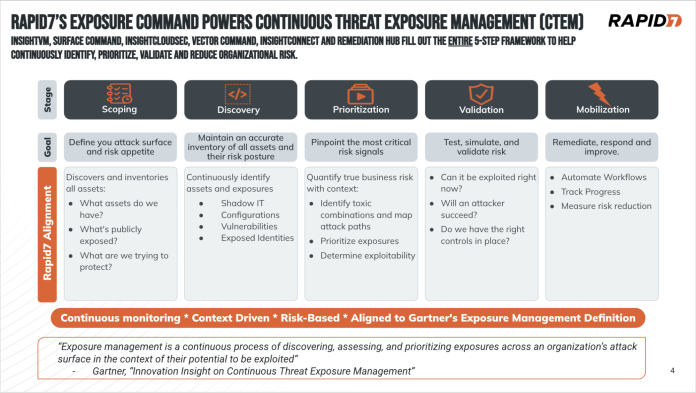
Let's be honest, the patching window just shrank to something no practitioner or organization can keep up with. Organizations now need to operate in an environment that must assume breach, which means fundamentals like attack surface management, micro-segmentation, identity management, and attack path validation – aka a few core pillars of CTEM – just became the most important initiatives...
MAXHUB Pivot Client Application
View CSAF
Summary
Successful exploitation of this vulnerability may enable an attacker to access tenant email addresses and associated information in cleartext or cause a denial-of-service condition.
The following versions of MAXHUB Pivot client application are affected:
MAXHUB Pivot client application
CVSS
Vendor
Equipment
Vulnerabilities
v3 7.3
MAXHUB
MAXHUB Pivot client application
Use of a Broken or Risky Cryptographic Algorithm
Background
Critical Infrastructure Sectors: Information Technology
Countries/Areas Deployed: Worldwide
Company Headquarters Location: United States
Vulnerabilities
Expand All...
Exploits and vulnerabilities in Q1 2026

During Q1 2026, the exploit kits leveraged by threat actors to target user systems expanded once again, incorporating new exploits for the Microsoft Office platform, as well as Windows and Linux operating systems.
In this report, we dive into the statistics on published vulnerabilities and exploits, as well as the known vulnerabilities leveraged by popular C2 frameworks throughout Q1 2026.
Statistics...
Woflow – 447,593 breached accounts
In March 2026, the AI-driven merchant data platform Woflow was named as a victim by the ShinyHunters data extortion group. The group subsequently published tens of thousands of files allegedly obtained from the company, comprising more than 2TB of data. The trove included hundreds of thousands of email addresses, names, phone numbers and physical addresses, with the data indicating...
Quantum Risk Explained
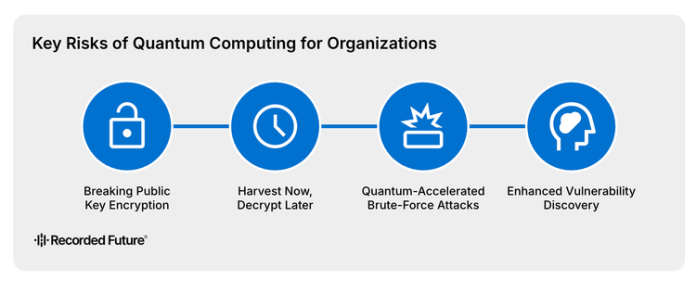
Summary Quantum computing is moving from theory toward early practical use, with direct implications for encryption, authentication, and long-term data confidentiality. The primary risk is the eventual emergence of cryptographically relevant quantum computers (CRQCs), which would break today’s public-key cryptography and undermine encryption, digital identity, and software trust at scale. Quantum risk is already present: “harvest now,...
Latest article

Yarbo Android/iOS Mobile Application and Cloud Infrastructure
View CSAF
Summary
Successful exploitation of these vulnerabilities could allow an attacker to obtain hard-coded credentials, gain access to telemetry data, and potentially send operational commands...
Check Point VPN Authentication Bypass Vulnerability
What is the Vulnerability? A critical authentication bypass vulnerability, CVE-2026-50751 (CVSS...
CISA tells agencies to patch smarter, not harder — foreshadowing broader industry practice
Security teams’ patching practices have come under intense pressure over the past year, as active exploitation is up, time-to-exploit windows...