In May 2026, Insikt Group® identified 41 high-impact vulnerabilities that should be prioritized for remediation, all of which had a Very Critical Recorded Future Risk Score. This represents an 11% increase from last month.
These vulnerabilities affected products from 20 vendors. 21 of the 41 vulnerabilities were included in the US Cybersecurity and Infrastructure Security Agency (CISA)’s Known Exploited Vulnerabilities (KEV) catalog, 19 were surfaced through honeypot data, and one was reported by a cybersecurity vendor.
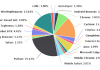
The 41 vulnerabilities in this report affected products from 20 vendors. Vercel accounted for approximately 27% of the vulnerabilities, driven by honeypot-sourced Next.js activity. The remaining exposure was concentrated across a range of enterprise software, security, networking, developer tooling, and cloud-related products.
Quick Reference: May 2026 Vulnerability Table
All 22 vulnerabilities below were actively exploited in May 2026. This table does not include the 19 CVEs associated with honeypot activity, which are available to Recorded Future customers via the CVE Monthly Report. The table below also provides examples of public PoCs identified by Insikt Group®. These PoCs were not tested for accuracy or efficacy. Vulnerability management teams should exercise caution and verify the validity of PoCs before testing.
Score
✓
(available to Recorded Future Customers)
Table 1: List of vulnerabilities that were actively exploited in May, 2026 based on Recorded Future data (excluding honeypot-sourced CVEs).
Key Trends: May 2026
- In May 2026, threat actors exploited a Ghost CMS vulnerability in large-scale ClickFix and FakeCaptcha poisoning campaigns.
- The campaigns used compromised Ghost CMS websites to inject malicious JavaScript, redirect victims through social engineering lures, and stage dropper and loader payloads from attacker-controlled infrastructure.
- 12 of the 41 vulnerabilities enabled remote code execution (RCE), affecting products from 8 vendors: Microsoft, Adobe, Langflow, Palo Alto Networks, Apache, openDCIM, Fortinet, and Ivanti.
- Insikt Group identified public proof-of-concept (PoC) exploits for 32 of the 41 vulnerabilities in this report.
- The most commonly observed flaws this month were CWE-79 (Cross-site Scripting), CWE-506 (Embedded Malicious Code), and CWE-89 (SQL Injection), with three CVEs each.
- 5 of the 41 vulnerabilities in this month’s prominent vulnerabilities table were first disclosed between 2008 and 2010, making them at least 15 years old, with the oldest vulnerability being approximately 18 years old.
- This reinforces our finding that attackers continue to exploit long-known weaknesses in environments where patching has lagged.
- Additionally, the fastest observed time from a vulnerability’s public disclosure to exploitation was less than one day.
Exploitation Analysis
This section highlights some of the highest-impact, actively exploited vulnerabilities this month, specifically those linked to known threat actor campaigns or that have public PoC exploits available. Vulnerabilities with no meaningful public technical detail are summarized in the disclosures table only.
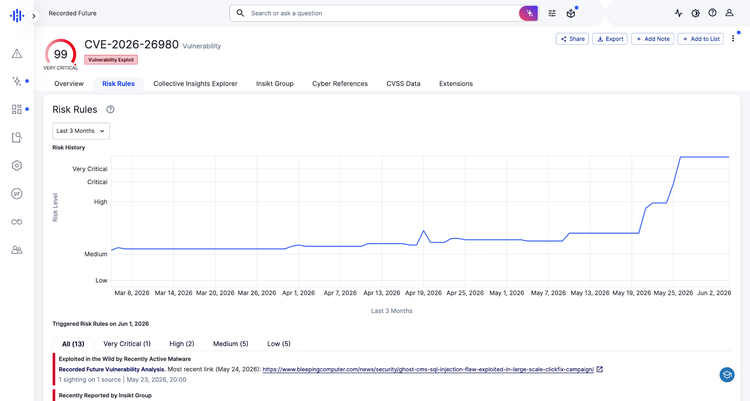
Threat Actors Exploit CVE-2026-26980 in Ghost CMS To Conduct Large-Scale ClickFix Poisoning Campaigns, Sample Available From Recorded Future Malware Intelligence
On May 21, 2026, cybersecurity firm XLab published a technical analysis detailing large-scale ClickFix poisoning campaigns targeting vulnerable Ghost Content Management System (CMS) instances by exploiting CVE-2026-26980. Ghost CMS allows users to create, manage, and publish content for blogs, media sites, newsletters, and subscription-based websites through a node.js-based publishing platform.
CVE-2026-26980 is a critical SQL injection vulnerability in Ghost CMS that allows unauthenticated threat actors to extract Ghost Admin API Keys and modify website content through the Ghost Admin API.
As previously reported by Insikt Group®, at least two threat groups exploited CVE-2026-26980 to inject malicious JavaScript into more than 700 compromised Ghost CMS websites across industries, including blockchain, artificial intelligence (AI), and financial technology (fintech). According to XLab, the threat actors used the compromised websites to deliver ClickFix and FakeCaptcha social engineering attacks that tricked victims into executing malicious commands and malware payloads on their systems.
Insikt Group® obtained one of the malicious samples, UtilifySetup.exe, from Recorded Future Malware Intelligence. The sample matched the sandbox YARA rule for detecting Inno Setup packaging. Based on sandbox and static code analysis, the sample performs the following actions on a victim’s machine:
- Conducts DLL injection
- Retrieves the system language and geolocation using the Windows registry
- Drops files named
UtilifySetup.tmp(SHA256: 7790fd1035266000ed6d6cc35822f7683f5271663af8a5b5effadff85316df6d) andGrape.exe - Enumerates files and directories
- Retrieves system information
- Delays execution using the Sleep API function for evasion
- Detects debuggers using the
GetTickCountAPI function to compare the timing and theIsDebuggerPresentAPI function - Creates a file inside the
C:\Users\user\AppData\Local\SuperMaxionQuickMaxlitedirectory, corroborating XLab’s analysis - Terminates running processes
Sandbox analysis categorized UtilifySetup.tmp as malicious due to the sample exhibiting discovery capabilities. Based on sandbox and static code analysis, the sample performs the following actions on a victim’s machine:
- Conducts DLL injection
- Retrieves the system language and geolocation using the Windows registry
- Executes
UtilifySetup.exeinstaller from the%Temp%directory using internal Inno Setup /SL5 launch parameters - Executes a file named
Grape.exeinside theC:\Users\user\AppData\Local\SuperMaxionQuickMaxlitedirectory
Once executed, Grape.exe performs the following actions on a victim’s machine:
- Adds a Windows registry Run key entry named
electron.app.Grapeset to execute itself when the victim logs in - Enumerates running processes
- Sends DNS request to
web-telegram[.]ug
Further technical details associated with this activity, including sample analysis, MITRE ATT&CK techniques, and IoCs, are available to Recorded Future customers via Insikt Group® reporting.
Recorded Future customers can also access Malware Intelligence queries that surface samples communicating with campaign-associated URLs, domains, and IP addresses.