[R1] Nessus Versions 10.11.4 and 10.12.0 Fixes Arbitrary File Deletion

Nessus Versions 10.11.4 and 10.12.0 Fixes Arbitrary File Deletion Jason Schavel Thu, 04/23/2026 - 14:30
A vulnerability has been identified in Nessus on Windows where an attacker to create a junction, enabling the deletion of arbitrary files with SYSTEM privileges. As a result, this condition potentially facilitates arbitrary code execution, whereby an attacker may exploit the vulnerability to...
[R1] Nessus Agent Version 11.1.3 Fixes Arbitrary File Deletion
Nessus Agent Version 11.1.3 Fixes Arbitrary File Deletion Jason Schavel Thu, 04/23/2026 - 14:10
A vulnerability has been identified in Nessus Agent on Windows where an attacker to create a junction, enabling the deletion of arbitrary files with SYSTEM privileges. As a result, this condition potentially facilitates arbitrary code execution, whereby an attacker may exploit the vulnerability to...
It pays to be a forever student

Welcome to this week’s edition of the Threat Source newsletter. If I haven’t said it in a newsletter before, I'll say it now: If you want to be good at cybersecurity, be a forever student. Cultivating and feeding your desire to know how things work is one of the key ingredients to being a hacker. It’s not always about understanding the micro details, but the macro...
Private health records of half a million Britons offered for sale on Chinese website
Technology minister tells Commons ‘de-identified’ information from UK Biobank advertised for sale on AlibabaThe confidential health records of half a million British volunteers have been offered for sale on Chinese website Alibaba, the UK government has confirmed.The “de-identified” data, belonging to participants in the UK Biobank project, was found for sale on three separate listings last week. Ian Murray,...
Google Favors General-Purpose Gemini Models Over Cybersecurity‑Specific AI
Google Cloud’s COO advocated for combining general-purpose frontier large language models with task-specific AI agents - Read more
UAT-4356’s Targeting of Cisco Firepower Devices

Cisco Talos is aware of UAT-4356's continued active targeting of Cisco Firepower devices’ Firepower eXtensible Operating System (FXOS). UAT-4356 exploited n-day vulnerabilities (CVE-2025-20333 and CVE-2025-20362) to gain unauthorized access to vulnerable devices, where the threat actor deployed their custom-built backdoor dubbed “FIRESTARTER.” FIRESTARTER considerably overlaps with the technical capabilities of RayInitiator’s Stage 3 shellcode that processes incoming XML-based payloads...
CVE-2026-32210 Microsoft Dynamics 365 (online) Spoofing Vulnerability
Server-side request forgery (ssrf) in Microsoft Dynamics 365 (Online) allows an unauthorized attacker to perform spoofing over a network. - Read more
AI is Changing Vulnerability Discovery and your Software Supply Chain Strategy has to Change with it
Wade Woolwine is Senior Director, Product Security at Rapid7.The headlines around Glasswing have focused on how quickly AI can surface vulnerabilities, which has naturally caught the attention of security leaders. In my conversations with teams and customers, the more useful discussion has been about what that speed means in practice for business protection, especially across open source risk, dependency...
Yuma AI – Unauthenticated personal data and order information disclosure
Yuma AI - Unauthenticated personal data and order information disclosure A vulnerability was identified in Yuma AI Chat AI (a chatbot), a SaaS solution integrated into multiple e-commerce websites. Chat AI allows any unauthenticated user to retrieve sensitive order information including purchased items and shipping addresses belonging to arbitrary customers, simply by providing a customer email address or an...
FIRESTARTER Backdoor
Malware Analysis Report at a Glance
Malware Name
FIRESTARTER
Original Publication
April 23, 2026
Executive Summary
The Cybersecurity and Infrastructure Security Agency (CISA) analyzed a sample of FIRESTARTER malware obtained from a forensic investigation. CISA and the United Kingdom National Cyber Security Centre (NCSC) assess advanced persistent threat (APT) actors are using FIRESTARTER malware for persistence, specifically targeting publicly accessible Cisco Firepower and Secure Firewall...
Latest article

GreatXML zero-day BitLocker bypass doesn’t seem to work, yet
A disgruntled researcher who has been publishing zero-day Microsoft Windows vulnerabilities for the past several months released a new exploit...
New Windows Zero-Day Claims BitLocker Bypass Amid Microsoft Disclosure Fight
A new Windows zero-day reportedly bypasses BitLocker, adding pressure on Microsoft as researchers debate the exploit’s real-world impact.
The post New Windows Zero-Day Claims BitLocker...
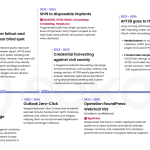
Fancy Bear Hackers Abuse EdgeRouters and Cloud Services to Launch Stealthy Cyberattacks
One of the most persistent hacking groups in the world has found a new way to stay hidden. The threat actor known as...
Ransomware Payment Crypto Laundering Platform Taken Out by FBI and Europol
Domain of dark web money laundering platform AudiA6 seized and suspects arrested in joint operation by the FBI, Europol and others - Read...