Patch Tuesday – January 2026
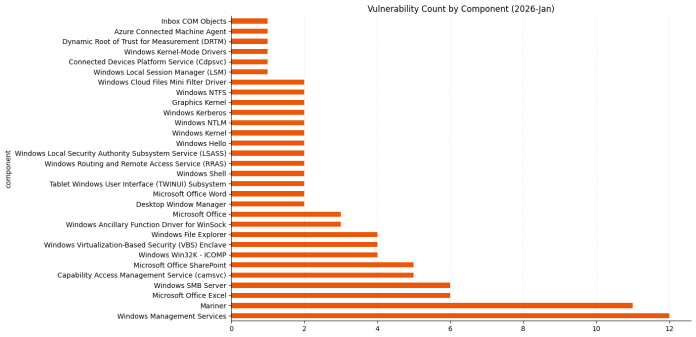
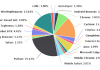
Microsoft is publishing 114 vulnerabilities this January 2026 Patch Tuesday. Today’s menu includes just one vulnerability marked as exploited in the wild, as well as two vulnerabilities where Microsoft is aware of public disclosure. There are no critical remote code execution or elevation of privilege vulnerabilities. So far this month, Microsoft has already provided patches to address one browser...
Unpatchable Vulnerabilities of Kubernetes: CVE-2020-8554

A look at how Kubernetes CVE-2020-8554 works - Read more
Microsoft Patch Tuesday for January 2026 — Snort rules and prominent vulnerabilities
Microsoft has released its monthly security update for January 2026, which includes 112 vulnerabilities affecting a range of products, including 8 that Microsoft marked as “critical”. In this month's release, Microsoft observed one of the included “important” vulnerabilities, CVE-2026-20805, as being exploited in the wild. Out of 8 "critical" entries, 6 are remote code execution (RCE) vulnerabilities in Microsoft Windows services and applications including Windows Local Security Authority Subsystem Service (LSASS), Microsoft Word, Microsoft Excel, and...
When AI Gets Bullied: How Agentic Attacks Are Replaying Human Social Engineering
AI Security Insights – January 2026 - Read more
Streamline security response at scale with AWS Security Hub automation

A new version of AWS Security Hub, is now generally available, introducing new ways for organizations to manage and respond to security findings. The enhanced Security Hub helps you improve your organization’s security posture and simplify cloud security operations by centralizing security management across your Amazon Web Services (AWS) environment. The new Security Hub transforms how organizations handle security...
Unauthenticated remote command injection
CVSSv3 Score: 9.4
An improper neutralization of special elements used in an OS command ('OS Command Injection') vulnerability in FortiSIEM may allow an unauthenticated attacker to execute unauthorized code or commands via crafted TCP requests.
Revised on 2026-01-13 00:00:00
- Read more
Unauthenticated access to local configuration
CVSSv3 Score: 9.3
An exposure of sensitive information to an unauthorized actor vulnerability in FortiFone Web Portal page may allow an unauthenticated attacker to obtain the device configuration via crafted HTTP or HTTPS requests.
Revised on 2026-01-13 00:00:00
- Read more
SSRF in GUI console
CVSSv3 Score: 3.4
A Server-Side Request Forgery (SSRF) vulnerability in FortiSandbox may allow an authenticated attacker to proxy internal requests limited to plaintext endpoints only via crafted HTTP requests.
Revised on 2026-01-13 00:00:00
- Read more
Heap-based buffer overflow in cw_acd daemon
CVSSv3 Score: 7.4
A heap-based buffer overflow vulnerability in FortiOS and FortiSwitchManager cw_acd daemon may allow a remote unauthenticated attacker to execute arbitrary code or commands via specifically crafted requests.
Revised on 2026-01-13 00:00:00
- Read more
Authenticated SQL injection in API endpoint
CVSSv3 Score: 6.8
An improper neutralization of special elements used in an SQL command ('SQL Injection') vulnerability in FortiClientEMS may allow an authenticated attacker with at least read-only admin permission to execute unauthorized SQL code or commands via crafted HTTP or HTTPs requests.
Revised on 2026-01-13 00:00:00
- Read more
Latest article

GreatXML zero-day BitLocker bypass doesn’t seem to work, yet
A disgruntled researcher who has been publishing zero-day Microsoft Windows vulnerabilities for the past several months released a new exploit...
New Windows Zero-Day Claims BitLocker Bypass Amid Microsoft Disclosure Fight
A new Windows zero-day reportedly bypasses BitLocker, adding pressure on Microsoft as researchers debate the exploit’s real-world impact.
The post New Windows Zero-Day Claims BitLocker...
Fancy Bear Hackers Abuse EdgeRouters and Cloud Services to Launch Stealthy Cyberattacks
One of the most persistent hacking groups in the world has found a new way to stay hidden. The threat actor known as...
Ransomware Payment Crypto Laundering Platform Taken Out by FBI and Europol
Domain of dark web money laundering platform AudiA6 seized and suspects arrested in joint operation by the FBI, Europol and others - Read...