Summary
Embodied AI has arrived.. Humanoid and quadruped robots are moving off factory floors and into everyday operations, military deployments, and critical infrastructure. Technological advances in large language models LLMs and robotics are enabling robots to perform complex tasks autonomously.
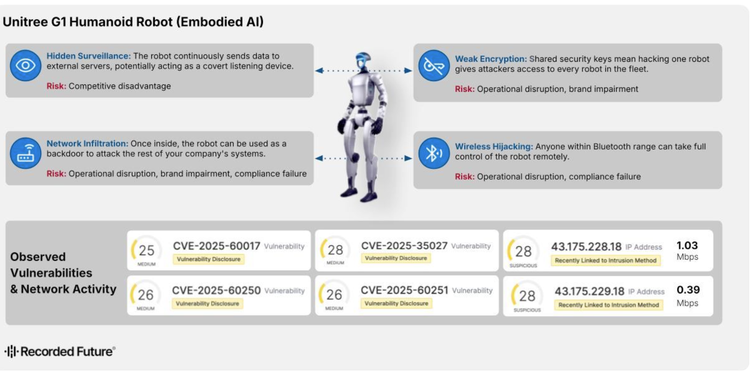
Security has not kept pace. Researchers have demonstrated that commercially available robots can be hijacked over Bluetooth, covertly exfiltrate audio, video, and spatial data to servers in China, and even infect neighboring robots wirelessly, forming physical botnets. If unaddressed, these security weaknesses are set to scale massively once humanoid robots are fully integrated into critical workflows.
The risks need to be taken extremely seriously. A robot should be treated less like a machine on the balance sheet and more like a cyber-physical endpoint with cameras, microphones, radios, cloud dependencies, and motors. That means tougher procurement, tighter network controls, continuous vulnerability monitoring, and a credible plan for operational continuity if a fleet has to be pulled offline.
Analysis
Market Drivers of Embodied AI Adoption
Embodied AI, intelligent systems in physical forms such as humanoid and quadruped robots, is moving from spectacle to staffing plans.
The shift is being driven as much by demographics as by technological progress. There are growing reports that the working-age population worldwide has begun to decline. China, an economic success story, has seen its population also decline again in 2025 as births hit a record low. These trends do not make large-scale automation inevitable, but they seriously strengthen the economic case for it in both corporate and government decision-making.
The International Federation of Robotics identifies labor shortages, real-world testing of humanoid robots, and increasing attention to safety and cybersecurity as defining trends for 2026. Some early deployments of embodied AI reinforce this trajectory. BMW reports that the Figure 02 humanoid robot has assisted in the production of more than 30,000 X3 vehicles, while GXO and Agility Robotics describe their partnership (established in 2024) as “the first formal commercial deployment of humanoid robots.” In high-risk environments, Sellafield is deploying quadruped robots to reduce human exposure in nuclear decommissioning.
Capital markets are also responding. Unitree filed for a reported $610 million initial public offering (IPO) in Shanghai in March 2026. Taken together, these signals suggest that robots are leaving pilot programs and becoming operational.
That transition makes the security question immediate rather than theoretical.
Expanding Attack Surface in Embodied AI Systems
Unlike traditional IT assets, embodied AI systems combine multiple high-risk components in a single platform: cameras, microphones, sensors, wireless radios, cloud connectivity, and physical actuation. This convergence creates a broad and under-secured attack surface.
A compromised robot can exfiltrate sensitive environmental and operational data, provide persistent remote access to internal networks, and interact physically with its environment, potentially causing unintended physical effects. This elevates robots from conventional endpoints to cyber-physical systems with both digital and real-world consequences.
The risk is compounded by architectural choices. Many platforms rely on cloud-dependent telemetry, wireless provisioning interfaces, and centralized control mechanisms. These design decisions create multiple entry points for attackers and increase the likelihood of compromise across entire fleets of embodied AI systems.
Demonstrated Vulnerabilities and Exploits
The risks are no longer theoretical. Documented vulnerabilities show that commercially available robots can be compromised with relative ease. Unlike traditional cyber threats, which mostly affect the digital world, exploiting robots enables attackers to manipulate the physical world, maximizing the potential for harm.
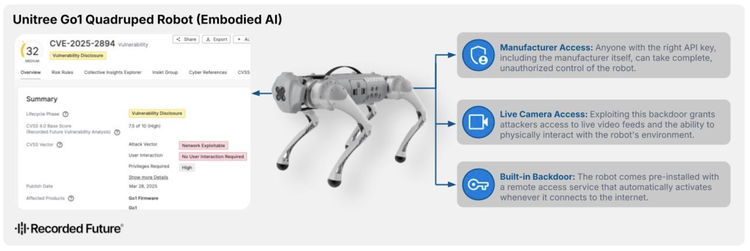
In 2025, researchers discovered an undocumented backdoor in Unitree’s Go1 quadruped robot that enabled remote access via the CloudSail service. Axios reported that an exposed web application programming interface (API) could allow attackers to locate devices globally and, if a robot was online, view live camera feeds without authentication. Where default credentials remained unchanged, full device control was possible. Whether described as a backdoor or a design failure, the implication is the same: robots may be reachable in ways operators do not anticipate, just like any other Internet of Things (IoT) device.
Further research disclosed a critical vulnerability in the Bluetooth Low Energy and Wi-Fi provisioning interface used by multiple Unitree models, including the Go2, B2, G1, R1, and H1 robots. According to both the UniPwn research and IEEE Spectrum, the flaw combined hard-coded cryptographic keys, trivial authentication bypass, and command injection in the Wi-Fi setup process. An attacker within radio range could obtain root-level access without physical contact, giving them control over the robot.
Because the exploit propagates wirelessly, a single compromised device can enable lateral movement across nearby robots. This creates a fleet-level compromise scenario in which multiple units can be controlled simultaneously. The result resembles a physical botnet capable of both digital and physical actions.
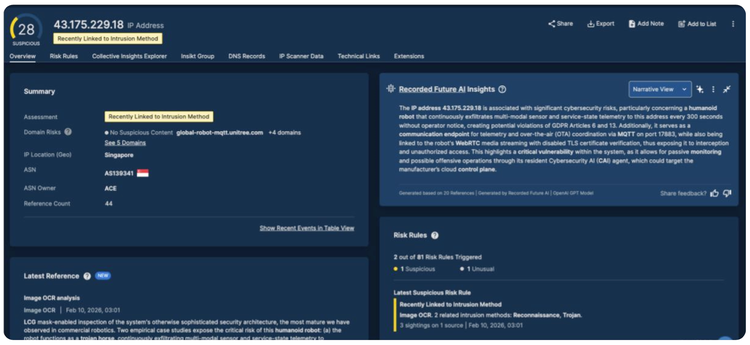
Surveillance risks are equally significant. Researchers wrote that the Unitree G1 robot continuously exfiltrated multimodal sensor and service-state telemetry every 300 seconds without the operator’s knowledge. This included streaming data to external servers, potentially including audio, video, and spatial mapping. A robot operating inside a plant or laboratory may therefore be mapping the environment in real time.
The attack surface extends beyond firmware and networking layers. Researchers showed they could take control of a Unitree humanoid in about a minute, bypass its normal controller, and trigger physical actions. Demonstrations at GEEKCon in Shanghai indicated that both voice commands and short-range wireless exploits could hijack robots and propagate attacks to nearby units, including those not actively in use.
At the software layer, embodied AI systems introduce additional risks due to their reliance on large vision-language models. Researchers demonstrated that physical-world text can influence system behavior, as injected visual prompts were shown to steer autonomous driving, drone landing, and tracking tasks without compromising the underlying software. This would enable threat actors to take control of a self-driving car or turn a drone into their own surveillance feed by embedding a visual prompt in the environment, such as hiding a message on a stop sign.
Systemic and Operational Risk Implications
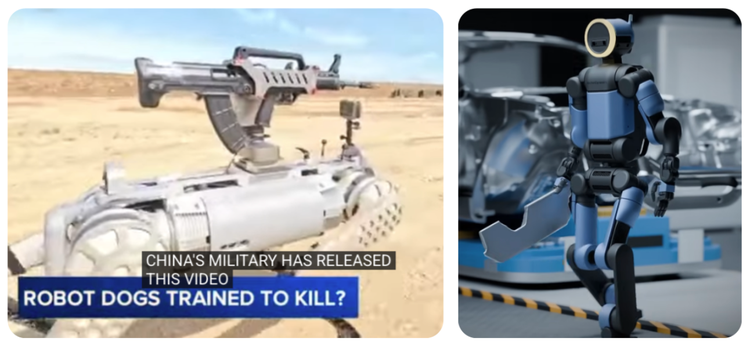
The implications extend beyond individual devices to organizational and systemic risk. Embodied AI systems are already being deployed in environments where compromise has consequences beyond data loss. Manipulation or malfunction of robots during critical operations would have outsized economic or public safety consequences. Militaries are also experimenting with robotic systems (see Figure 4).
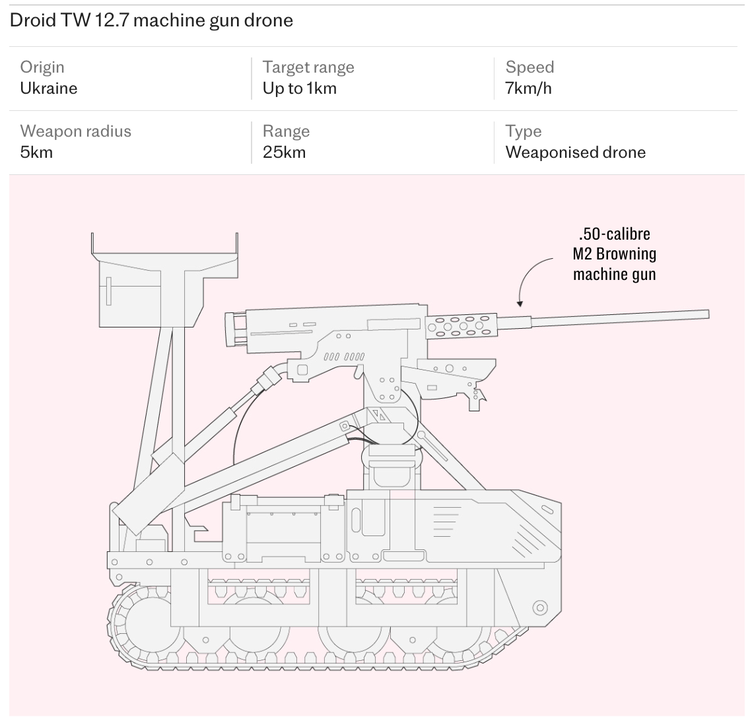
In 2024, the Golden Dragon exercise between Cambodia and China featured robot dogs among the systems on display. Meanwhile, in the US, politicians have begun pushing for Unitree to be designated as a federal supply-chain risk, reflecting national security concerns about commercial robotics platforms. This is a very similar move to Poland’s ban on sensor-rich vehicles accessing military sites to limit surveillance risk. Ukraine has successfully deployed ground-based robots and drones in combat operations, marking a significant shift in modern warfare. In a landmark operation in April 2026, Ukrainian forces captured a Russian position using only unmanned systems — the first recorded instance of a robot-only assault in the conflict.
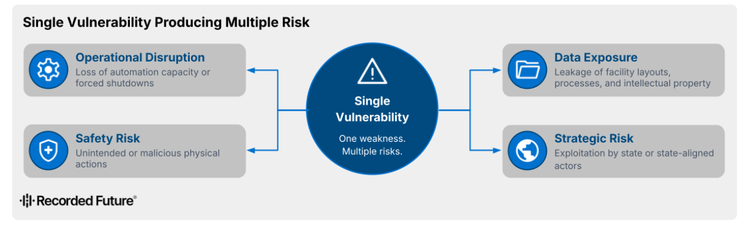
As adoption scales, these risks become interconnected. A vulnerability affecting one platform or vendor could propagate across fleets, sites, or sectors, creating systemic exposure.
At the same time, the pace of commercial development is outstripping regulatory oversight. Bank of America estimates that as many as three billion humanoid robots could be in operation by 2060. This convergence of demographic pressure, advancing AI capabilities, and falling production costs suggests that large-scale human-machine coexistence is highly probable.
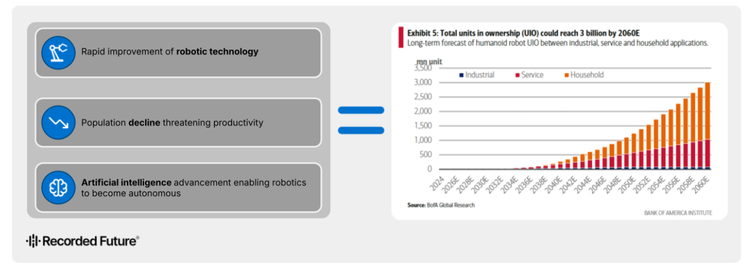
Figure 7: Summary of the factors fueling growth in robotics production, illustrated by Bank of America data
(Source: Recorded Future)
Securing embodied AI systems is therefore not a peripheral technical issue. It is a strategic requirement that must be addressed before widespread deployment locks in insecure architectures at scale.