Sign in
  • Home
  • About Us
  • Services
    • Email Archive Service
    • Messaging Security Service
    • Malware Protection Security Service
    • SIEM & Cybersecurity Operations Centre (CSOC) Services
    • Backup Service
  • Solutions
    • Cybersecurity
    • Connectivity, Voice & Hosting
    • Managed IT Services
    • Enterprise Content & Information Management
  • Cyber News
  • Contacts
Sign in
Welcome!Log into your account
Forgot your password?
Password recovery
Recover your password
Search
Sign in
Welcome! Log into your account
Forgot your password? Get help
Password recovery
Recover your password
A password will be e-mailed to you.
Dataproof Communications
  • Home
  • About Us
  • Services
    • Email Archive Service
    • Messaging Security Service
    • Malware Protection Security Service
    • SIEM & Cybersecurity Operations Centre (CSOC) Services
    • Backup Service
  • Solutions
    • Cybersecurity
    • Connectivity, Voice & Hosting
    • Managed IT Services
    • Enterprise Content & Information Management
  • Cyber News
  • Contacts
Home Cyber News Imperva Blocks Our Largest DDoS L7/Brute Force Attack Ever (Peaking at 292,000...
  • Cyber News
  • Imperva

Imperva Blocks Our Largest DDoS L7/Brute Force Attack Ever (Peaking at 292,000 RPS)

By
Editor Dataproof
-
24/07/2019
0
1459
Share on Facebook
Tweet on Twitter

Imagine you’re a developer building a new web application. You’ve followed all of the security best practices, hired a reputable penetration testing company before launch, and gone through extensive bug fixing to remove any vulnerabilities. However, would you be confident that your application could survive the largest and longest DDoS attack that you’d ever seen?

Targeting the authentication component of your site, this DDoS attack was led by a botnet coordinating 402,000 different IPs, lasted 13 days and directed a peak flow of 292,000 RPS (Requests Per Second). Such a massive attack is more than possible — one of our CDN customers in the entertainment industry was hit by one earlier this spring. 

It was the largest Layer 7 DDoS attack Imperva has ever seen (see below, click to enlarge). However, our application security successfully mitigated the attack during its entire 13-day span. So despite the ferocity, our customer suffered no downtime. 
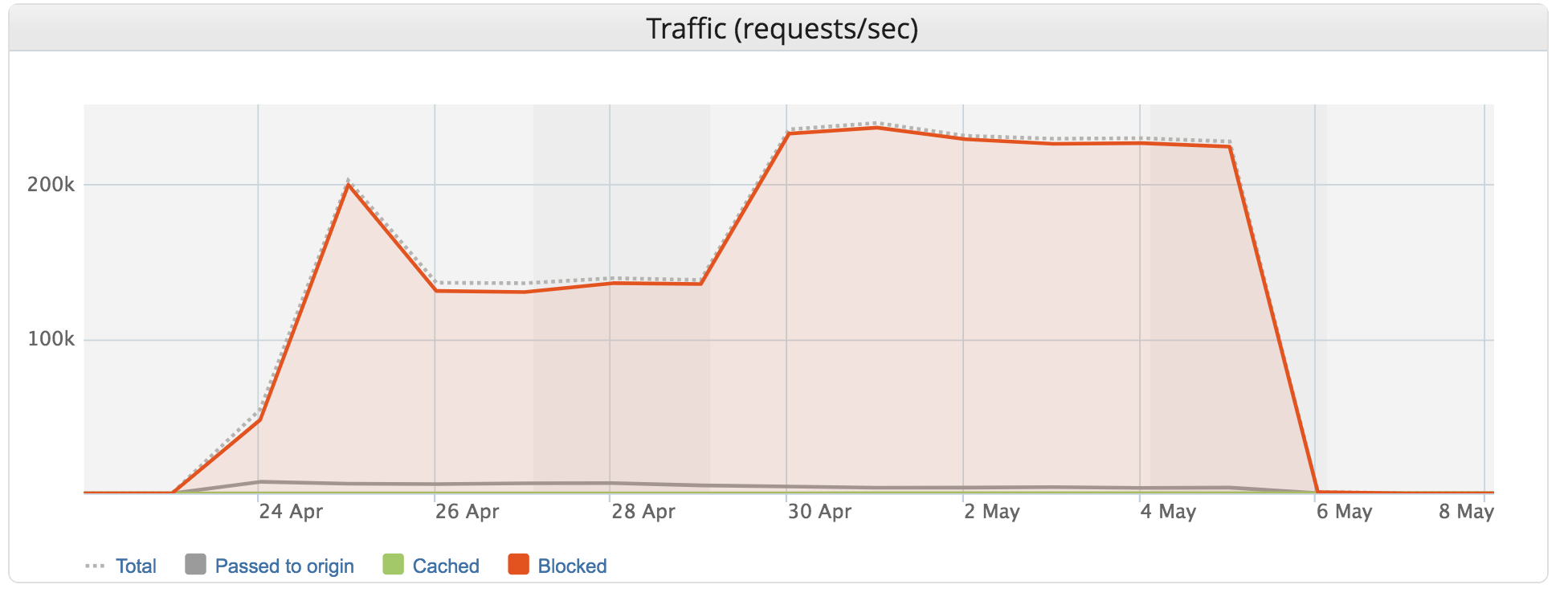
Layer 7 attack

Imperva has mitigated Layer 3/4 attacks that, using a different measure, peaked at 500 million packets per second. This, however, was the largest DDoS Layer 7 (application layer) attack to date we have observed, using the most relevant measure for Layer 7 attacks, Requests Per Second (You can read more about the types of DDoS here).

Attack Analysis

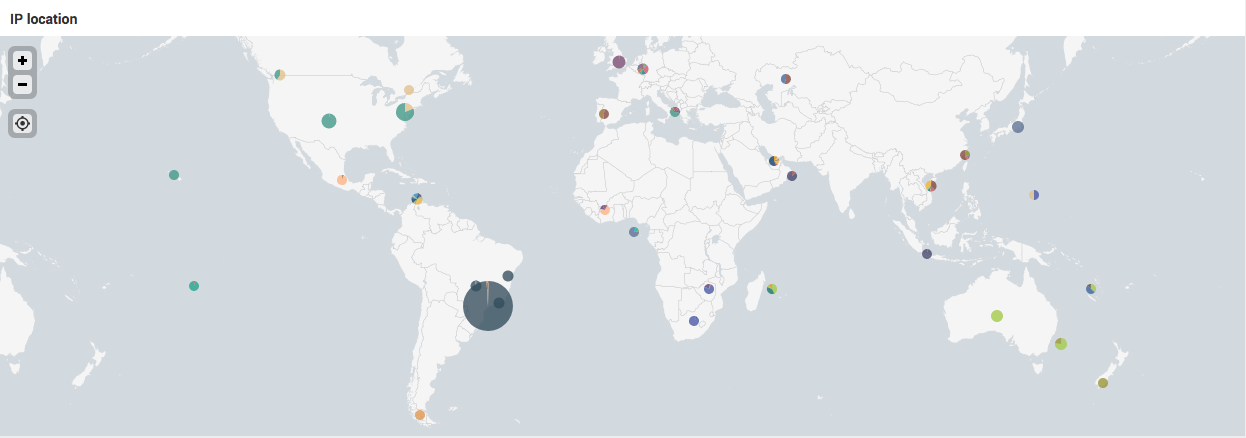
By analyzing the IPs that performed the attack, we found that the main source was Brazil.
The attackers used a legitimate User-Agent, the same as used by the entertainment industry customer service application, to mask their attack. In spite of this, our client classification mechanism could distinguish it from the customer’s legitimate application.

For a time, the attack targeted the authentication component of the streaming application. We are not sure if the intent of the attackers was to perform a brute force attack or DDoS attack, but without an accurate mitigation mechanism, the result was the same — denial of service.

Imperva recently released a new capability of our Application Security suite called Account Takeover Protection to protect against advanced account takeover attacks like brute force or credential stuffing. As this attack occurred in late spring before the launch of ATO, we were unable to analyze the brute force aspects of the attack.

So we began looking for a common denominator. We found that most of the IPs had the same opened ports: 2000 and 7547. These are associated with IoT devices infected by the Mirai malware according to the cybersecurity blog, Recorded Future.

Mirai Is Still Alive and Evolving

We analyzed Mirai back in 2016, and published a detailed investigation:“Breaking Down Mirai: An IoT DDoS Botnet Analysis”.

Following the release of Mirai’s source code some years ago, many new variants have emerged. Some of them just included additional IoT device default credentials to target more vendors’ devices, while others added new functionality.

Compromising the IoT device is the first part of the attack. Thereafter, the attacker uploads malicious software to the device that will receive commands from a Command and Control server (CnC). Mirai source code contains only DDoS functionality, but nothing prevents the attacker from including other malicious software to take advantage of compromised devices and perform additional attacks, such as brute force.

Summary

Since 2016, many new IoT vendors have entered the market. Few have learned from the security mistakes of the past. As a result, today IoT devices are used in most of the large botnets we have seen. 

Botnets of IoT devices will only get larger. We live in a connected world, so the number of IoT devices continues to grow fast and vendors still do not consider security a top priority.

It is almost impossible to protect your business and your applications from a DDoS attack at this scale without assistance. You need a 3rd party vendor that can handle both Application Layer 7 DDoS attacks and Network Layer 3/4 DDoS attacks.

If we look again at this attack from a brute force (or Account Takeover) perspective, mitigation may seem easy. Can’t you simply limit the rate of authentication attempts on your application? 

However, a botnet with 400,000 IPs can perform a “slow and low” attack: each IP tries a few logins,  goes inactive, and then tries a few more. In such a technique, the access rate is very low, mimicking legitimate login attempts, and staying under rate limit policies.  You can protect yourself, your business and your reputation by using the Account Takeover Protection capability of Imperva’s Application Security stack. Stay safe!

The post Imperva Blocks Our Largest DDoS L7/Brute Force Attack Ever (Peaking at 292,000 RPS) appeared first on Blog.

– Read more

  • TAGS
  • account takeover
  • Application Security
  • botnet
  • DDoS attack
  • DDoS mitigation
  • internet of things
  • IoT
  • layer 7 attack
  • mirai
  • requests per second
SHARE
Facebook
Twitter
  • tweet
Previous articleNew 3-Second DDoS Mitigation SLA is 3x Faster and the Industry’s Best
Next articleEnabling Faster DDoS Mitigation for Cloud Assets
Editor Dataproof

RELATED ARTICLESMORE FROM AUTHOR

Cyber News

Labyrinth Chollima Evolves into Three North Korean Hacking Groups

Cyber News

Zimbra Collaboration Local File Inclusion

Cyber News

How to get started with security response automation on AWS

Cyber News

I’m locked in!

Cyber News

Exposed Open Directory Leaks BYOB Framework Across Windows, Linux, and macOS

Cyber News

Identitäten im Fokus von Cyberkriminellen

RSS Security Awareness Tips

Latest article

Labyrinth Chollima Evolves into Three North Korean Hacking Groups

Cyber News Editor Dataproof - 30/01/2026
0
CrowdStrike assessed that two new threat actor groups have spun off from North Korean Labyrinth Chollima hackers - Read more

Zimbra Collaboration Local File Inclusion

Cyber News Editor Dataproof - 30/01/2026
0
What is the Vulnerability? A Local File Inclusion (LFI) vulnerability (CVE-2025-68645)...

How to get started with security response automation on AWS

Cyber News Editor Dataproof - 29/01/2026
0
At AWS, we encourage you to use automation. Not just to deploy your workloads and configure services, but to also help you quickly detect...

I’m locked in!

Cyber News Editor Dataproof - 29/01/2026
0
Welcome to this week’s edition of the Threat Source newsletter.I’ve struggled a lot over the last few years with balance. I want to follow the...

EDITOR PICKS

Labyrinth Chollima Evolves into Three North Korean Hacking Groups

30/01/2026

Zimbra Collaboration Local File Inclusion

30/01/2026

How to get started with security response automation on AWS

29/01/2026

Find us

Dataproof Communications
Block 09 Pinewood Office Park
33 Riley Road
Woodmead 2128
South Africa
Phone: 011 032 7700
Fax: 011 032 7788

POPULAR POSTS

Threats to users of adult websites in 2018

21/02/2019

The World’s Most Popular Coding Language Happens to be Most Hackers’...

26/09/2018

IT threat evolution Q2 2019

19/08/2019

Operating Hours

Monday08:00 - 17:00
Tuesday08:00 - 17:00
Wednesday08:00 - 17:00
Thursday08:00 - 17:00
Friday08:00 - 17:00

POPULAR CATEGORY

  • Cyber News945
  • Tech News658
  • Kaspersky153
  • Imperva139
  • Tripwire101
  • Centrify97
  • Infoblox72
  • Fortinet26
  • Tenable20

Equity and Structure

The company has a level 2 B-BEE rating with 63% black ownership, with a team of passionate professionals with over 30 years of experience in ICT industry. Our vision is to be a world class leader in cyber security incident management and response solutions.

ABOUT US
DataProof Communications is Cybersecurity Company incorporated in 2014 specialising in cybersecurity operations, incident management and response best practices and technologies. DataProof’s objective is to provide comprehensive cybersecurity solutions through people, processes and technology to help organisations protect the confidentiality, integrity and availability of their ICT assets.
Contact us: info@dataproof.co.za
  • Home
  • About Us
  • Services
    • Email Archive Service
    • Messaging Security Service
    • Malware Protection Security Service
    • SIEM & Cybersecurity Operations Centre (CSOC) Services
    • Backup Service
  • Solutions
    • Cybersecurity
    • Connectivity, Voice & Hosting
    • Managed IT Services
    • Enterprise Content & Information Management
  • Cyber News
  • Contacts
© Dataproof Communication 2018
MORE STORIES

Labyrinth Chollima Evolves into Three North Korean Hacking Groups

30/01/2026

Zimbra Collaboration Local File Inclusion

30/01/2026

How to get started with security response automation on AWS

29/01/2026
Edit with Live CSS
Save
Write CSS OR LESS and hit save. CTRL + SPACE for auto-complete.